Can you believe I almost forgot I had a blog? So in a belated effort to avoid become one of those MIA bloggers that have disappointed me in the past, I offer this little nugget of content and the possibility of an ongoing series of posts.
One of the things that I've been doing besides blogging is volunteering to cook at a local social services center that works with the homeless population in the area. As part of their day program, they provide three meals a day. A cold breakfast, a hot lunch, and a bagged meal to take for dinner. At first, I started out one day a week, just helping the employee in charge of the kitchen. Soon, I was responsible for the cooking the entire meal that day, from planning to plate. Usually it was an effort in scavenging and improvisation. There is an intense need to make do with what was on had and to use up donated food items. The situation was dire mainly because the kitchen employee was unskilled, unambitious, and entirely lacking in confidence. This lead to some really poor meals. Canned green peas were frequent side dish on the menu. I was proud to introduce scratch cooking and stuff like fresh vegetables to menu.
Unfortunately for the center, the employee in charge of the kitchen left at the beginning of this year. Despite her culinary deficiencies, she was an exceptionally nice and giving person, and will be sorely missed. This left a cooking vacuum in the kitchen, and I was luckily able to arrange my schedule to help out. Now I get to cook for these folks more often.
The point of this block of exposition is to introduce some cheap, easy blog content by the way of what I cooked for the soup kitchen, and hopefully some pithy observations (don't hold your breath on that one).
This week we had:
25 January 2013

01 April 2012
Puffy Parathas

Sadly, I ran out of rice to eat with the palak tofu I made from Andrea Nuygen's Asian Tofu book (I recommend it!), so I had to turn to bread. The traditional pairing for saag dishes are roti made from corn, but I decided to forgo tradition and make some parathas. Parathas are a rich, unleavened, flat bread made from a simple wheat flour and water dough. The way they are deep fried gets them to puff up like pita bread. The trick is to fry it in hot oil, and baste the top of the bread by ladling or splashing hot oil over it while it cooks. This helps generate steam faster, and makes a skin that retains the steam for longer. Once out of the frier, they don't stay puffed for too long, so serve them quickly for maximum effect. The oil I used is vegetable oil, but I had previously cooked carnitas and tohu goreng bacem (twice cooked coriander tofu, also from Asian Tofu), so it was very flavorful.
The recipe such as it is:
AP Flour (may use a fraction or all whole wheat) 100
Water 60
Salt 1
26 March 2012
Okara Granola Mark 1

In it's current form and formula, the okara doesn't hold its crispness long enough. Needs work.
25 March 2012
Making Tofu: The Soy Milk
First you gotta soak your soybeans. There's a whole time and tempurature curve involved. Just soak them over night. You want them to be uniformly hydrated and crumble easily between your thumb and finger. I discarded the soaking water. You'll want to puree them as fine as possible in a blender. Remember when adding your water to the blender to blend the beans, you need to ration it. Since I'm making block tofu, which calls for light soy milk, I can only use 1.33 cup of water per ounce of dry soy bean. In this case, I'm allowed 21 cups of water for 16 oz of soybeans. It'll take a few minutes to get the bean puree, or go, fine enough. The first half of my beans weren't pureed as fine as they should have been, and I think that impacted my tofu yield. Pour your go into a big pot, and proceed to cooking. Some folks have you already heat part of your water ration in the pot while you puree the beans. This has the advantage of speeding up your cooking time and limits the soy's 'beany' taste because you are allowing the enzymes that you released during blending less time to work on the soybean's oils and proteins.


19 March 2012

18 March 2012
And they call it dumpling love...

14 March 2012
Modernist Chile Con Queso Part 1
I got a hankering for chips and dip the other night. Salsa wouldn't cut it, I wanted cheese. The kind of creamy gooey cheese you get on convenience store nachos. The kind I'd been reading about how you can make it at home in Modernist Cuisine. So I took a look at the recipes from the 'constructed cheese' parametric table, and cobbled together a formula based on what I had in the pantry.
08 March 2012
Making Your Own Tofu Press
Last week, I bought Andrea Nguyan's new cookbook on tofu for my Kindle. http://www.vietworldkitchen.com/blog/2012/03/asian-tofu-enhanced-ebook.html (I also own her Asian Dumplings book on Kindle, which is excellent.) I've only scratched the surface, but it's enticing. I've made the Ma Po Tofu from it twice, and the pork-kimchee-tofu mandu once so far. Asian Tofu strikes me as a reincarnation of Shurtleff and Ayogi's Book of Tofu. My only gripe with Asian Tofu is the lack of technique for making puffy fried tofu.
Anyway, I was paging through Asian Tofu and dreaming of making fresh tofu. I had everything I need, but a press. The plastic press looked kinda dinky, and I didn't want to pay out the nose for an expensive Japanese wooden one. I also wanted something reusable, so the disposable loaf pan idea was also out. After looking at the picture of the wooden press in the book, got to thinking that I could make this. So I went to Home Depot and came back with about 10 bucks worth of poplar cuts and gorilla glue.

Anyway, I was paging through Asian Tofu and dreaming of making fresh tofu. I had everything I need, but a press. The plastic press looked kinda dinky, and I didn't want to pay out the nose for an expensive Japanese wooden one. I also wanted something reusable, so the disposable loaf pan idea was also out. After looking at the picture of the wooden press in the book, got to thinking that I could make this. So I went to Home Depot and came back with about 10 bucks worth of poplar cuts and gorilla glue.

07 March 2012
Irish Soda Bread
Saint Patrick's Day is coming up quickly, and I've been put in charge of cooking the Paddy's Day feast at my local community center. We're doing the required corned beef, potatoes and carrots, braised cabbage, horseradish, and of course soda bread.
 Soda breads became popular in Ireland because they could only grow soft wheat reliably. Hard wheat just wasn't suited for that region. Soft wheat flour lacks the protein needed to trap the gasses produced during yeast fermentation, so the Irish needed to turn to chemical leaveners to do the job. At first, this was done by a combination of acidic buttermilk and one of a variety of alkaline carbonate salts. Sometime in the 19th century, baking powder started to be incorporated into soda breads. Our modern baking soda (sodium bicarbonate) eventually became the default alkaline in the Western baking world.
It's worth mentioning that soda bread is part of the farl and scone continuum of the British Isles. If you can master soda bread, you can easily master the others. In Ireland, the addition of the raisins and caraway technically puts us in the category of tea breads (sweeter and garnished soda breads) rather then soda bread proper. This is, then, an Irish American version of soda bread. Since we generally eat it only once a year (if that), we can be a little extravagant.
 Irish Soda Bread Formula in Baker's Percentages
AP Flour .....................100
Baking Soda ...................1.25
Salt .................................1.25
Sugar ..............................5
Baking Powder ...............5
Butter ...........................10
Raisins ..........................20
Caraway Seed ................1.25
Buttermilk .....................70
....................................213.25
Mixing Method: Biscuit
Scale at ~1lb (450g) per unit
Makeup: Ball shaped loaf scored with a deep cross.
Baking: 375 deg F ~30-40 minutes.
NB: Plump up the raisins with a little hot water after scaling, then drain.

It's worth mentioning that soda bread is part of the farl and scone continuum of the British Isles. If you can master soda bread, you can easily master the others. In Ireland, the addition of the raisins and caraway technically puts us in the category of tea breads (sweeter and garnished soda breads) rather then soda bread proper. This is, then, an Irish American version of soda bread. Since we generally eat it only once a year (if that), we can be a little extravagant.

AP Flour .....................100
Baking Soda ...................1.25
Salt .................................1.25
Sugar ..............................5
Baking Powder ...............5
Butter ...........................10
Raisins ..........................20
Caraway Seed ................1.25
Buttermilk .....................70
....................................213.25
Mixing Method: Biscuit
Scale at ~1lb (450g) per unit
Makeup: Ball shaped loaf scored with a deep cross.
Baking: 375 deg F ~30-40 minutes.
NB: Plump up the raisins with a little hot water after scaling, then drain.
08 September 2011
Chicken Katsu
Woah, how did I forget about this place for the entire summer? Anyway, here is a post on chicken katsu, which I made the other day. Pictures forthcoming.
Katsu is a perfect example of loan cuisine. The Japanese picked up the cutlet technique (along with many others) from European traders. In fact there is an entire genre of Europe/Western via Japan cuisine. Blahblahblah...
Ok, I forgot to get eggs, otherwise I'd have done the standard breading procedure. I got good results with this erstaz method.
1) Butterfly chicken breast and pound them out. Cut them in half. Season.
2) Make a thick batter of wheat flour (bread), water, salt, fresh ground black pepper. Toss with the chicken.
3) Dredge the cutlets in panko. Press the crumbs down to get a good coat.
4) Let rest to get good adhesion. (optional)
5) Pan fry. Takes surprisingly little oil.
Basically, I could have just said, make a chicken cutlet.
So, what do you do with your crispy, brown, and delicious cutlets?
Traditionally, it's served with thinly shredded cabbage, rice, and a Japanese version of A1 steak sauce, and maybe a wedge of lemon. Also popular are katsu sandwiches. As for me, I like katsu curry. Steamed rice, Japanese style curry (to be subject of an upcoming blog post if I do it sans curry brick), and sliced chicken katsu.
There is also another exceptional Japanese fried chicken dish. Karaage. Nuggets of chicken are marinated and tossed in starch (varies from potato, corn, rice flour, and/or wheat flour), then fried.
Katsu is a perfect example of loan cuisine. The Japanese picked up the cutlet technique (along with many others) from European traders. In fact there is an entire genre of Europe/Western via Japan cuisine. Blahblahblah...
Ok, I forgot to get eggs, otherwise I'd have done the standard breading procedure. I got good results with this erstaz method.
1) Butterfly chicken breast and pound them out. Cut them in half. Season.
2) Make a thick batter of wheat flour (bread), water, salt, fresh ground black pepper. Toss with the chicken.
3) Dredge the cutlets in panko. Press the crumbs down to get a good coat.
4) Let rest to get good adhesion. (optional)
5) Pan fry. Takes surprisingly little oil.
Basically, I could have just said, make a chicken cutlet.
So, what do you do with your crispy, brown, and delicious cutlets?
Traditionally, it's served with thinly shredded cabbage, rice, and a Japanese version of A1 steak sauce, and maybe a wedge of lemon. Also popular are katsu sandwiches. As for me, I like katsu curry. Steamed rice, Japanese style curry (to be subject of an upcoming blog post if I do it sans curry brick), and sliced chicken katsu.
There is also another exceptional Japanese fried chicken dish. Karaage. Nuggets of chicken are marinated and tossed in starch (varies from potato, corn, rice flour, and/or wheat flour), then fried.
13 May 2011
Chicken and Blackmushroom Baozi
Sorry, not much introduction for this entry. Instead of a short history and etymology of baozi I'll just leave it at: Hey, I made some baos tonight!
Here's the formula for baozi dough I've been using. It's more of a northern style dough then Catonese style. That means it's not cake like in texture, nor as sweet. Northern style bao and mantou are chewier.
100 Bread Flour
2 Yeast
2 Oil/Fat
2 Sugar
1 Salt
1 Baking Powder
60 Water
Mixing method: Straight Dough
Whiteness of the finished product wasn't the highest priority for me. It is in China, and a lot depends on type of flour and dough ph. Higher protein levels and higher ph can both make the dough less white.
The filling for this batch I made with:
Dried black/shitake mushrooms
Hand minced chicken breast
Small diced carrot
Minced ginger and garlic
Oyster sauce
Hoisin sauce
Flour/water slurry for thickening
I stir fried the stuff together, added the sauces, and used the slurry to thicken it up. You want a very thick filling, paste like even. With these seasonings, it was a bit close in flavor to classic bbq pork puns.
Make up method for bao is pretty simple. Let dough proof once, section and round off balls, flatten and roll balls (thinner around the edge, thicker in the middle), fill, pleat, short second proof, cook.
The classic cooking method is to put them on a little piece of wax paper and steam them, but I took a technique from Shanghai and cooked them as sheng jian bao. It's esientally the same method as a pot sticker.
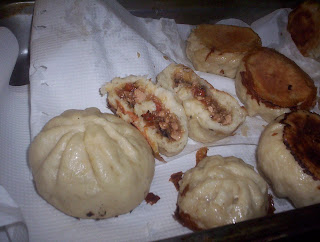
Here's the formula for baozi dough I've been using. It's more of a northern style dough then Catonese style. That means it's not cake like in texture, nor as sweet. Northern style bao and mantou are chewier.
100 Bread Flour
2 Yeast
2 Oil/Fat
2 Sugar
1 Salt
1 Baking Powder
60 Water
Mixing method: Straight Dough
Whiteness of the finished product wasn't the highest priority for me. It is in China, and a lot depends on type of flour and dough ph. Higher protein levels and higher ph can both make the dough less white.
The filling for this batch I made with:
Dried black/shitake mushrooms
Hand minced chicken breast
Small diced carrot
Minced ginger and garlic
Oyster sauce
Hoisin sauce
Flour/water slurry for thickening
I stir fried the stuff together, added the sauces, and used the slurry to thicken it up. You want a very thick filling, paste like even. With these seasonings, it was a bit close in flavor to classic bbq pork puns.
Make up method for bao is pretty simple. Let dough proof once, section and round off balls, flatten and roll balls (thinner around the edge, thicker in the middle), fill, pleat, short second proof, cook.
The classic cooking method is to put them on a little piece of wax paper and steam them, but I took a technique from Shanghai and cooked them as sheng jian bao. It's esientally the same method as a pot sticker.

Look at the filling to bread ratio, you won't get that from a restaurant!
26 April 2011
Pierogi!
I <3 pierogi. Believe it or not, I've never had them before now. Yes it's true. They sound like something I'd like. They feature a lot of my favorite ingredients: potato, mushrooms, saurkraut, dry fruit. Somehow I'd just never gotten around to eating them.
Flash forward to today. I was getting a hankering for potato and cheese, and my healthy diet resolve was starting to yield to the pressure of animal fries from In~n~Out and those wonderfully soggy chili cheese fries from Tommy's. Then bam, it hit me. Pierogi! I had all the stuff I needed to make at home, and I could satisfy my cravings while continuing my explorations of the dumpling continuum (Pretentious!).

I didn't work from a recipe, just from a classic flavor combination. Here's what I added:
2 ea onions, small diced and caramelized
8 oz sharp cheddar, small diced
2 c instant mashed potato (Don't judge me! It's what I had in the pantry.)
TT salt
TT black pepper
AN water
cold water jiaozi dough
This will yield you a bunch of pierogi. I've only made 15 for lunch, and it barely made a dent in the filling. Sadly, I forgot to add garlic, which would be tasty.
Forming is the same for jiaozi, pleats optional and not traditional. Boil them in salted water until the dough is cooked. Serve them, or crisp them up in a oiled pan on the stove.
I'm going to try and make some prune pierogi with some of those prunes haunting my cabinet.
Flash forward to today. I was getting a hankering for potato and cheese, and my healthy diet resolve was starting to yield to the pressure of animal fries from In~n~Out and those wonderfully soggy chili cheese fries from Tommy's. Then bam, it hit me. Pierogi! I had all the stuff I needed to make at home, and I could satisfy my cravings while continuing my explorations of the dumpling continuum (Pretentious!).

Boiled and panfried pierogi finished with black pepper.
I didn't work from a recipe, just from a classic flavor combination. Here's what I added:
2 ea onions, small diced and caramelized
8 oz sharp cheddar, small diced
2 c instant mashed potato (Don't judge me! It's what I had in the pantry.)
TT salt
TT black pepper
AN water
cold water jiaozi dough
This will yield you a bunch of pierogi. I've only made 15 for lunch, and it barely made a dent in the filling. Sadly, I forgot to add garlic, which would be tasty.
Forming is the same for jiaozi, pleats optional and not traditional. Boil them in salted water until the dough is cooked. Serve them, or crisp them up in a oiled pan on the stove.
I'm going to try and make some prune pierogi with some of those prunes haunting my cabinet.
Pimple Dumplings aka Knot Dumplings aka Mian Geda
Pimples? Knots? Chinese homophones, what a pain. In this case it's only a curiosity and not a source of family discord (like if you just called your MIL a horse because you forgot the right inflection). Geda aka 疙瘩, can mean either a pimply warty skin bump, or a knot. A similar issue presents itself with mian aka 面, which can mean noodle or face, among other things. So in naming the noodle you could end up with 面疙瘩, the noodle, or 疙瘩面, the pizza face. (at least according to google translate).
Which is the 'authentic' translation? I'm going to have to go with pimple dumplings. It's descriptive, as they do look like warty pimply bumps. It's also poetic, fitting in with Chinese food naming tradition. Further, there is a long world wide tradition of giving sophomoric names to foods (cf Italian nun farts, nun breasts, priest stranglers, etc). That said, I doubt I'd menu this item as pimple dumpling. Given current perceptions of Chinese dining predilections, your average western diner might assume they are being served literal pimples.
These noodles are featured in a genre of soups called pimple soup aka gedatang, 汤疙瘩, as well as stews. The soup is euphemistically called 'dough drop soup.' I have a hunch they are also stir fried like Nian Gao, but I haven't confirmed this.
Back to the cooking!
There are three ways to make this dumpling that I know of. The first is you make a thick batter and drop little bits off into boiling or simmering liquid. The second, novel approach, is to drizzle water into a pile of flour while stirring to make clumps, which are then cooked like pasta. The third is to make a dough, and break off little nuggets to form the dumplings, then boil them. I chose to test this second approach because I already used the first and third in Western applications.
For 100g of flour, I used 56g of water. I used AP wheat flour. You could also try rice flour, in all or part. You may need more or less water, so don't rely too much on the recipe. The amount you need is heavily dependent on humidity and the qualities of the flour. Your mileage WILL vary. Drizzle in a little water, and stir. Once you get lumps, shake the bowl so the big lumps settle to the top. Push them aside, so you can drizzle water onto and stir the unincorporated flour and smaller dough bits. Continue until there is no more loose flour. Break up any lumps that are too big with your fingers. If you are going to let the raw dough sit for any length of time, toss with a little flour to keep them from sticking together. When you're done, it should look something like this (sadly these were not as uniform as I would have liked):

Cooking the dumplings is pretty easy, Just dump them into simmering or boiling liquid for ~1-2 minutes (but always rely on your senses, not the clock). The cooked dumpling should have a firm chew, with the dough being completley cooked. There should be no raw flour taste or texture. I cooked this batch in boiling salted water since I was making pasta for dinner, and not soup. (I also tossed the cooked dumplings in the pasta sauce to make a real dog's dinner. Sadly I forgot to take a picture of cooking and cooked dumplings by themselves). Cooking directly in the soup seems to be the preferred method since it contributes extra body. The dough seems like it would handle par cooking well, but it cooks so quick, I wouldn't bother for most applications.
The bottom line? It's a quick, simple technique that is suitible for both Western and Asian applications. In fact, it closely replicates the taste and texture of one of my favorite restaurant's spaetzle. I'm adding it to my repertoire.

http://eatingasia.typepad.com/eatingasia/2011/04/dumpling-knots.html
Which is the 'authentic' translation? I'm going to have to go with pimple dumplings. It's descriptive, as they do look like warty pimply bumps. It's also poetic, fitting in with Chinese food naming tradition. Further, there is a long world wide tradition of giving sophomoric names to foods (cf Italian nun farts, nun breasts, priest stranglers, etc). That said, I doubt I'd menu this item as pimple dumpling. Given current perceptions of Chinese dining predilections, your average western diner might assume they are being served literal pimples.
These noodles are featured in a genre of soups called pimple soup aka gedatang, 汤疙瘩, as well as stews. The soup is euphemistically called 'dough drop soup.' I have a hunch they are also stir fried like Nian Gao, but I haven't confirmed this.
Back to the cooking!
There are three ways to make this dumpling that I know of. The first is you make a thick batter and drop little bits off into boiling or simmering liquid. The second, novel approach, is to drizzle water into a pile of flour while stirring to make clumps, which are then cooked like pasta. The third is to make a dough, and break off little nuggets to form the dumplings, then boil them. I chose to test this second approach because I already used the first and third in Western applications.
For 100g of flour, I used 56g of water. I used AP wheat flour. You could also try rice flour, in all or part. You may need more or less water, so don't rely too much on the recipe. The amount you need is heavily dependent on humidity and the qualities of the flour. Your mileage WILL vary. Drizzle in a little water, and stir. Once you get lumps, shake the bowl so the big lumps settle to the top. Push them aside, so you can drizzle water onto and stir the unincorporated flour and smaller dough bits. Continue until there is no more loose flour. Break up any lumps that are too big with your fingers. If you are going to let the raw dough sit for any length of time, toss with a little flour to keep them from sticking together. When you're done, it should look something like this (sadly these were not as uniform as I would have liked):

The dough ready to cook,
Cooking the dumplings is pretty easy, Just dump them into simmering or boiling liquid for ~1-2 minutes (but always rely on your senses, not the clock). The cooked dumpling should have a firm chew, with the dough being completley cooked. There should be no raw flour taste or texture. I cooked this batch in boiling salted water since I was making pasta for dinner, and not soup. (I also tossed the cooked dumplings in the pasta sauce to make a real dog's dinner. Sadly I forgot to take a picture of cooking and cooked dumplings by themselves). Cooking directly in the soup seems to be the preferred method since it contributes extra body. The dough seems like it would handle par cooking well, but it cooks so quick, I wouldn't bother for most applications.
The bottom line? It's a quick, simple technique that is suitible for both Western and Asian applications. In fact, it closely replicates the taste and texture of one of my favorite restaurant's spaetzle. I'm adding it to my repertoire.

The cooked dumplings (the white lumps).
http://sunflower-recipes.blogspot.com/2009/09/chinese-spatzle-soup-gedatang.html
http://eatingasia.typepad.com/eatingasia/2011/04/dumpling-knots.html
23 April 2011
Cocktail Notebook
Three things I want to try:
Dark And Stormy- Dark rum (supposed to be Gosling's), ginger beer (hard to find a good ginger beer here, maybe DIY it?), lime juice. On rocks.
French 75- Champagne, gin, simple syrup, lemon juice
Guinness Punch- Guinness, sweetened condesed milk, cinnamon, nutmeg, cocao powder on top.
Dark And Stormy- Dark rum (supposed to be Gosling's), ginger beer (hard to find a good ginger beer here, maybe DIY it?), lime juice. On rocks.
French 75- Champagne, gin, simple syrup, lemon juice
Guinness Punch- Guinness, sweetened condesed milk, cinnamon, nutmeg, cocao powder on top.
21 April 2011
Jamie Oliver's Food Revolution
At least he can say his hearts in the right place... Season 2 of Jamie's Food Revolution in America is interesting, but does he have to be such a moppet?
My main issues with him:
-He's lost all his business sense. He got into a big argument with a diner owner over replacing 1.75/lb ground beef with 3.90/lb ground beef, and mislabeling yogurt smoothies as milkshakes. While his style of food may taste good (the diner owner and customers agreed), Jamie needs to realize there is a time and place for it. I also don't like his fast and loose ethics and general manner of forcing the changes.
-He leads schools to failure. In his first experiment with school lunches in England, he provoked a general revolt. The kids refused to eat the food, the lunch ladies were verging on striking because of 'overwork', and he was way way over budget. When he revisited the school, his lunch program was still poorly received and was in dire financial straights because of his extravagances and decision to close the schools profit center snack shop.
-Cheap scaremongering. The teaser on his first show shows him telling kids that they make ice cream out of beavers, and put ammonia into beef. Regarding beavers, an extract of beaver musk is used as a small component of some vanilla and raspberry flavorings. So what, we use animal derived ingredients in our food all the time, from animal fats, and animal broths, to extracts like cochineal and cà cuống. If you're telling people to tuck into a free range hamburger, you shouldn't be upset if your dessert has a little teeny tiny free range beaver in it. I just don't get it
Regarding the ammonia issue, the gaseous ammonia treatment for beef trim is essentially no different from the carcass rinses used to sanitize them after gutting and splitting. Further he ignores the all the naturally occurring ammonia in every day foods, ammonia production in the body, and its widespread use in food. Even oreo style cookies depend on ammonia gas for their unique texture.
-I don't like condescension. I don't think anyone does.
Will you still watch it?
Yup. I think improving school lunches is a good thing. And the show is pretty entertaining in its own right. I think he's going it about it in a bad way. I'd start by kick out these bad purchasing decisions where they are using microwave meals to feed kids, and start seeing what I can make in house with regular ingredients.
My main issues with him:
-He's lost all his business sense. He got into a big argument with a diner owner over replacing 1.75/lb ground beef with 3.90/lb ground beef, and mislabeling yogurt smoothies as milkshakes. While his style of food may taste good (the diner owner and customers agreed), Jamie needs to realize there is a time and place for it. I also don't like his fast and loose ethics and general manner of forcing the changes.
-He leads schools to failure. In his first experiment with school lunches in England, he provoked a general revolt. The kids refused to eat the food, the lunch ladies were verging on striking because of 'overwork', and he was way way over budget. When he revisited the school, his lunch program was still poorly received and was in dire financial straights because of his extravagances and decision to close the schools profit center snack shop.
-Cheap scaremongering. The teaser on his first show shows him telling kids that they make ice cream out of beavers, and put ammonia into beef. Regarding beavers, an extract of beaver musk is used as a small component of some vanilla and raspberry flavorings. So what, we use animal derived ingredients in our food all the time, from animal fats, and animal broths, to extracts like cochineal and cà cuống. If you're telling people to tuck into a free range hamburger, you shouldn't be upset if your dessert has a little teeny tiny free range beaver in it. I just don't get it
Regarding the ammonia issue, the gaseous ammonia treatment for beef trim is essentially no different from the carcass rinses used to sanitize them after gutting and splitting. Further he ignores the all the naturally occurring ammonia in every day foods, ammonia production in the body, and its widespread use in food. Even oreo style cookies depend on ammonia gas for their unique texture.
-I don't like condescension. I don't think anyone does.
Will you still watch it?
Yup. I think improving school lunches is a good thing. And the show is pretty entertaining in its own right. I think he's going it about it in a bad way. I'd start by kick out these bad purchasing decisions where they are using microwave meals to feed kids, and start seeing what I can make in house with regular ingredients.
20 April 2011
Indian Style Vegetable Fritters

Test Fritters
I took advantage of my unexpected bounty of zuchini to make some vegetable fritters for dinner. I first had these at this Sri Lankan joint near my house on my first day of public school. The stand was in one of those converted keysmith/photodevelopers huts you sometimes see in shopping center parking lots. They eventually razed the place to make room for more cars. I lost track of them after that. Man, did they have some good food... I got the combo of chicken curry (with curry leaves in it!), rice, the fritters, and a large serving of spicy as hellfire red coconut chutney. I've come close to duplicating that chutney, but that is a subject for another post.
Anyway, these deep fried morsels of goodness, aka bhajji or pakora depending what kind of Indian you are, are easy to make. They come in two major styles. One is the tempura style, where large pieces of vegetable are dipped in batter and fried. The other style is what I call the 'hushpuppy' style. Small bits of vegetable are mixed into the batter, and spoonfuls are dropped into the frying oil. I made mine according to this style.

Please don't notice my unprofessional lack of a fry thermometer.
There are also different schools of thought on batter composition. The base is usually chickpea flour, but may include additions of wheat or rice flour. It may also include other lentil flours (usually urad daal) in addition too or in place off the chickpea flour. I used a pure chickpea flour this time around.
Master Formula For Pakora Batter
100 chickpea/garbanzo bean flour aka besan
100 Water
200 Vegetables*
7.5 Baking Powder
Seasonings To Taste
*Vegetables should be in small pieces or shredded. Some veggies have tons of excess moisture, like zucchini, that will need to be dealt with.
Tonight I used 200g of flour, 200 gram of water, ~400g of shredded zucchini and sliced green onion (~5 zuch's and 1 bunch of scallion), ~15ml of dried fenugreek leaves aka methi, and 15g of baking powder. The zucchini was salted and pressed before I weighed it. There is a lot of water to get rid of, using a fine strainer will help you when it comes time to squeeze the water out. The more you tighten your grip, the more zucchini shreds will slip through your fingers. (Star Wars, it's a classic.) I seasoned it with tumeric, cumin, corriander seed, asfaetoida, red chili powder, and garam masala, for a mildly spiced bhajji.

The batter before mixing with water
The texture is like that of thick applesauce.

Das Batter

GBD on the outside, soft and fluffy on the inside.
We had a light dinner for 2 with this amount and some salad, and almost a pint left of batter. Accompany this meal with a simple daal and some rice for more substantial fare.
Classic main ingredient variations in this style are spinach or other green, potatoes, or onions.
Serve this with some green chutney, and tamerand chutney. I didn't have the stuff to make the green chutney, so I just made some tamarand chutney. I missed the green chutney.
1 cup raisons chopped (I used pitted prunes because that is what I had on hand, and they were tasty in the chutney)
1/3 cup tamerand concentrate (Amount needed will very depending on the type and brand of your concentrate, Use your taste and judgement)
1/4 cup brown sugar
~1/2 cup lemon juice (Optional, I had some left over that was kicking around in the fridge. I tossed it in to clear space. It was tasty)
1 tablespoon minced/grated ginger
Season to taste with cumin, red chili, garam masala, and salt (use black salt if you're hard corp)
Toss it all in a pot, add some water, and simmer for a while until the tastes and textures blend (Maybe half an hour to 45 min? I just left it on the stove to cook on low, while I got everything else ready and cleaned up). You can toss it in a blender if you like, but I just mashed it with a potato masher while it cooks so mine is a little chunky. Yields about 3 cups. It's a lot like ketchup, but less tangy and without that glutamate punch from the tomatoes.
IT'S HERE!!!!!!
Just picked up the scale from the post office. It seems like a pretty good scale. Lightweight, fast read, and runs on AAA batteries rather then some exotic type. Here's the one I got and a link so you can get one too, if you want:
http://www.amazon.com/Ozeri-Digital-Kitchen-Capacity-Stylish/dp/B003E7AZQA/ref=sr_1_8?s=kitchen&ie=UTF8&qid=1303329827&sr=1-8
I will test its accuracy later. It weighed my full water bottle (a recycled Powerade bottle) in at 1018 g. The bottle has a rated capacity of 946ml (or 946g of water), but I didn't tare out the bottle weight, and I overfilled it. All in all, my rough guess is that it's accurate. It amazes me you can really accurate scientific type scales at Amazon for about the same price or less, as well as calibration weights. Not sure when I'd need to measure out 0.001g of Salt though. Maybe if it was for molecular gastronomy...
Hopefully I'll get to see how it performs in the kitchen, tonight. Right now I'm weighing stuff in my office. It will also take a while to see how it fares, endurance wise. If it craps out in less then a year, expect a post full of profanity and broken dreams.

http://www.amazon.com/Ozeri-Digital-Kitchen-Capacity-Stylish/dp/B003E7AZQA/ref=sr_1_8?s=kitchen&ie=UTF8&qid=1303329827&sr=1-8
I will test its accuracy later. It weighed my full water bottle (a recycled Powerade bottle) in at 1018 g. The bottle has a rated capacity of 946ml (or 946g of water), but I didn't tare out the bottle weight, and I overfilled it. All in all, my rough guess is that it's accurate. It amazes me you can really accurate scientific type scales at Amazon for about the same price or less, as well as calibration weights. Not sure when I'd need to measure out 0.001g of Salt though. Maybe if it was for molecular gastronomy...
Hopefully I'll get to see how it performs in the kitchen, tonight. Right now I'm weighing stuff in my office. It will also take a while to see how it fares, endurance wise. If it craps out in less then a year, expect a post full of profanity and broken dreams.

The precious...(and my pasty palm)
The Scale Has Arrived!
I just have to go to the post office and pick it up. I'm thinking of also taking the opportunity to switch to metric. It would sure make culinary math easier.
Out with: A pint's a pound, the world around (except for Australia)
In with: A liter's a kilogram, the... the...
Ok, so maybe metric isn't that snappy.
Out with: A pint's a pound, the world around (except for Australia)
In with: A liter's a kilogram, the... the...
Ok, so maybe metric isn't that snappy.
What's Up Next?
Of course, if I make something else interesting, or eat at a interesting place, I'll blog about that too. I'm also thinking about doing a semi-weekly feature focusing on a basic technique for people unskilled in the kitchen, and an even less regular feature interviewing people in the food service world.
Pictorials/How to make:
Cong You Bing- Chinese scallion flatbread
Shao Bing- Chinese sesame flatbread
Niu Rou Xian Bing- Chinese beef/flatbread roll.
Jian Bing- Chinese crepe with egg cooked on one side
Injera- Ethiopian sourdough crepe
Char Sui- Chinese BBQ pork
Xiao Long Bao- Soup dumplings
Sheng Jien Bao- Panfried steamed bao
Daal with Pumpkin
Vietnamese 'Sate-style' Hot Sauce
Equipment Reviews:
Unicorn Mills Magnum Peppermill
My new scale
Pictorials/How to make:
Cong You Bing- Chinese scallion flatbread
Shao Bing- Chinese sesame flatbread
Niu Rou Xian Bing- Chinese beef/flatbread roll.
Jian Bing- Chinese crepe with egg cooked on one side
Injera- Ethiopian sourdough crepe
Char Sui- Chinese BBQ pork
Xiao Long Bao- Soup dumplings
Sheng Jien Bao- Panfried steamed bao
Daal with Pumpkin
Vietnamese 'Sate-style' Hot Sauce
Equipment Reviews:
Unicorn Mills Magnum Peppermill
My new scale
19 April 2011
Review: Kogi BBQ Food Truck
Around about 5pm today, I was surfing the web and hit on Kogi's website, http://kogibbq.com . According to their schedule, their truck would be my dad's neighborhood tonight. My dad's a sucker for Korean BBQ. It was one of his signature dishes (He swears by Ebara brand sauce/marinade). I knew he'd be down for it. One phone call and a couple hours later, my dad and I were standing in line. Kogi is one of the most hailed concepts of the Southern California food truck revolution. They feature a fusion of Korean BBQ meats and flavors, on a Mexican platform.

Here's what we had:

The short rib taco was probably the best of what we had. The bbq was some of the best I've ever had, with some nice char. It was totally boneless very little sinew/cartilage bits, a nice bonus. The website menu calls the cut 'short rib trimmings.'

This was my least favorite. Basically it's a quesadilla filled with Korean bbq chicken and chedder cheese. It's topped with their orange flavored salsa, and a sprinkling of sesame seeds. The flavors didn't really do it for me, and the mulitas were undercooked. They gotta be crispy folks!


My dad liked it, and he'd go again. I would go at least once more. I want to try their version of a burger, and their desserts; a chocolate tres leches cake, and some sort of siracha flavored chocolate rice crispy turtle bar. I'd also bring some tea or beer to drink. The food is just too sweet to drink with the soda or juice they offer.

The truck.
There was a decent sized crowd. Always at least 5-10 people in line, and about the same waiting for food. The wait wasn't too bad. I wasn't timing or anything, but I think we spent around 10-20 at the truck, and that included time to figure out the menu and waiting to order.

Short Rib Taco $2.10 a la carte
The short rib taco was probably the best of what we had. The bbq was some of the best I've ever had, with some nice char. It was totally boneless very little sinew/cartilage bits, a nice bonus. The website menu calls the cut 'short rib trimmings.'

Blue Moon Mulitas $3 for one/$5 for two
This was my least favorite. Basically it's a quesadilla filled with Korean bbq chicken and chedder cheese. It's topped with their orange flavored salsa, and a sprinkling of sesame seeds. The flavors didn't really do it for me, and the mulitas were undercooked. They gotta be crispy folks!

Spicy Pork Burrito $5

Inside the burrito
The burrito wasn't too bad. It featured some nice Korean style spicy pork. I think it was even char grilled a little, which worked well with the gochuchang marinade.
The Good:
- Really, really, really good korean BBQ. I'd be happy with a bowl of rice and some bbq.
- Accessible fusion food.
- Decent value. We each got a combo #2; 1 burrito, 1 taco, and a drink (canned soda) for 8 bucks.
The Bad:
- Everything was sweet. Oh so sweet. Just about too sweet too eat for me. This I think was unbalanced when combined with the Mexican elements. That lime wedge with the taco made a HUGE difference for the better.
- Meh salsas. I didn't like the salsa naranja much, but that might have just been in combination with the mulitas. I'll be sure to ask for some on the side next time so I can investigate them further.
- Undergriddled tortillas for tacos, so they didn't lose they stale texture and taste that tortillas get if they aren't super fresh. Already mentioned the under cooked mulitas.
- Where's my kimchi, bro?!?! That kimchi looking stuff is just a slaw of lettuce and cabbage with some sort of soy-sesame-chili sauce. I found out later, if you want real kimchi, the tangy fermented stuff, it's an extra charge.
The Ugly:
- Not real convenient. You can't just pop down if you're in the mood for a bulgogi taco. You need to plan ahead, otherwise the truck could on the other side of town or out of service for the day. You'll need to keep an eye on their website and twitter. This is a fault of the new wave food truck business model, not this truck in particular.
- If you want your food to go (and you will because it's a freaking food truck), you have to wrap the food up and bag it yourself. I counted 5-6 guys inside the truck. At least one of them could put a frigging lid on my tacos.
Would You Go Again?:
My dad liked it, and he'd go again. I would go at least once more. I want to try their version of a burger, and their desserts; a chocolate tres leches cake, and some sort of siracha flavored chocolate rice crispy turtle bar. I'd also bring some tea or beer to drink. The food is just too sweet to drink with the soda or juice they offer.
Review In One Sentence:
Good Korean style BBQ, the rest needs work.
Subscribe to:
Posts (Atom)